Showing posts with label write. Show all posts

Sunday, April 3, 2016

Tales from Midwest Memories: The Soap Opera Scandal of '88


*All names have been changed to protect the guilty and innocent, but mostly, the guilty.

As I sat in Mr. Johnson’s office and waited on my mom to arrive, I chewed on my cuticles and wondered how this got so out of control. The situation began innocently enough – a joke made among friends during study hall.
Monday study hall dragged on with no end in sight. Gina, Rene, Chrissy, and I had been friends since elementary school. Our freshmen year, we found ourselves outcasts in a school containing less than two hundred students, so we adopted the motto: “us against the world.” We sat together at the table nearest the window and shared the weekend’s gossip in whispers and giggles, shaking our heads and rolling our eyes at the deceit and debauchery engaged in by our classmates.
“Ya know, this place is like a soap opera,” Gina muttered.
I laughed at the idea, pulled out a piece of paper, jotted down the words “As Valley High Turns,” and sketched out a crudely rendered picture of the earth at the bottom of the page.
“Just think, what a soap opera we could write. These stories would be just as good as anything on tv,” I whispered, showing the girls the page.
The girls nodded in agreement, and in that moment, we conceived a monumental idea. By the time the bell rang, we had drawn up our cast of “characters.” We included students, faculty, staff, and administrators because how realistic would it be to write a show set in a school with no adults? We discussed plot lines, love triangles, and all matters of degenerate behavior based on our classmates’ actual lives. I gathered up all the notes, and we headed our separate ways. I hurried to Mrs. Deeley’s history class to work on the script.
On Tuesday, I shared my work with the girls during study hall. They “oohed” and “aahed” at all the proper places, then grabbed their pencils and began making notes on the script, snickering as they worked. After class, I took the piece and began making the changes and additions suggested along with some of my own invention as well.
The rest of the week flew by in the same manner. The girls read during study hall and made their notes. I took their input and revised, reworked, and added as necessary. By Friday, the script had grown from a teasing suggestion to a substantial piece of writing that filled a two-pocket folder. The girls made their notes for the day, and I took it home with me.
Over the weekend, I neatly rewrote the entire script. I created an official looking cover from two pieces of cardboard and assembled it using brass-headed brads. The final copy of our “story” occupied the front and back of fifty college-ruled loose-leaf pages, detailing every piece of information the four of us knew or observed at Valley High School filled in with constructions of logical interactions and reactions dreamt up in our teenage minds.
I carried the manuscript to school on Monday morning and passed it to the girls. Chrissy took it first, then Rene, and finally Gina. We discussed the story at lunch. Each of us identified our favorite parts, and we declared the project a success.
After lunch, Gina ran to my locker. Out of breath with wide eyes, she panted, “It’s gone!”
“Whadda ya mean ‘it’s gone’?” I asked.
“The story. Someone took it outta my locker. IT is gone!”
“Who?”
Gina shook her head, “No idea.”
While I considered the possibility that there would be some turmoil over the story, I did not bother deliberating over it for long. I went on with my day as if nothing happened. Miss Bonnie came to get me at the beginning of eighth hour, and as soon as I saw her pursed lips and narrowed eyes, I realized the manuscript was going to cause more trouble than I thought.
Mr. Johnson frowned at me from behind his large wooden desk with his arms crossed over his chest. A photocopy of the manuscript sat in the center of his desk, taunting me. I guess he did not appreciate his bumbling, but charmingly clueless, portrayal.
“Are you responsible for this?” he asked, pointing at the stack of paper.
I frowned and nodded.
“Your mother has been called. She is on her way,” he stated, and then he stood and left the room, tripping over the edge of the bookshelf on his way out the door.
I could not help but smile.
Miss Bonnie glared at me from her perch by the front counter, involuntarily pulling at her tight purple sweater and running her lavender lacquered nails through her perfectly coiffed hair. I guess she did not appreciate her role as the aging prom queen making desperate advances on senior boys while trying to cling to her youth.
Through the front office window, I spied “Princess” Jennifer storm by with “Prince” Jonathon just a few steps behind her. She paused long enough to stare daggers at me through the glass. Her mascara ran down her cheeks. When John caught up to her and reached out to touch her shoulder, she jerked away from him and continued down the hall. He followed with his arms out and palms up, his mouth running a mile a minute trying to make it right. I am certain neither of them appreciated the exposure of the first-hand accounts of “Prince” John’s late night exploits.
Mom finally arrived. She sat straight and tall in the seat beside me with her hands folded in her lap and nodded at all the appropriate times, while Mr. Johnson explained my offenses and my punishment. She signed my referral sheet, folded her copy in half, and slipped it into her purse. She cleared her throat at the office door, and I jumped up from my seat and followed her out of the building.
The consequences surrounding the uproar were substantial. The senior and junior girls threatened to “give me an ass-whoopin’” for the next month. My mom grounded me for two weeks for “being disrespectful to my elders.” Mr. Johnson sentenced me to a week in the broom closet that also served as the school’s in-school-suspension room for writing “lewd and lascivious materials, better-suited for adults than proper young ladies.”

At the tender age of fourteen, I learned an important lesson about the power of words, and it was all worth it.

Friday, May 22, 2015

What's in a Name?


Do our names really influence who we will become?


I mean, we don't get to choose them, that honor is left up to our well-meaning, but occasionally clueless, parents. And for the most part, we live with whatever moniker has been foisted upon us by emotionally-compromised fathers or mothers who may or may not have had a little too much pain medication prior to completing our birth certificate. It is not a typical matter for deep philosophical reflection. Unless you were the victim of an extremely malicious parent like that unfortunate boy named Sue, then you probably suffered no lasting trauma associated with your name.


Not long ago, I was asked, "Do you love your name? Or hate it?" The question itself implies that people fall in one of two very distinct camps. But after a great deal of reflection, I decided there are too many gray areas involved to give a definitive answer. Over the course of my life, there have been many times I didn't particularly care for my name, but for better or worse, it is mine. So, here is my answer to that well-meaning, but poorly phrased, question.


It Could Have Been Worse

Before I came to live in this world, my mom and dad engaged in a typical debate held between couples readying themselves for the arrival of a new family member. They could not agree on a name. Although they each produced solid arguments for their choices and tenaciously defended their positions, my mom emerged the winner. Victorious, she named me Carey – but it could have been worse.

People have always struggled with the proper spelling of my name. In an attempt to make a common name less ordinary, Mom decided a change in spelling was necessary.  Businesses, employers, friends, and even family have frequently misspelled my name over the course of my life. My own grandpa never learned to spell my name accurately, which led to the receipt of yearly handwritten birthday greetings addressed to C-a-r-r-y, C-a-r-r-i-e, C-a-r-y, and even K-e-r-r-y. Of course, it could have been worse. Even though the name is misspelled, I still know they are talking to me. They could have gotten the name completely wrong. Can you imagine being referred to as Terry or Sherry or even as Mary. Misspelling doesn’t seem quite so bad when compared to misidentification.

Elementary school was no picnic either. Do you know how many words rhyme with Carey? A lot, that’s how many. Fairy Carey, Merry Carey, Scary Carey, Hairy Carey. Small children love to speak in verse, and when you have a name custom-made for rhyming, that is exactly what you get. However, it could have been worse. These monikers could have followed me into adolescence. Can you imagine being saddled with ‘Hairy Carey’ throughout puberty? That could have been truly devastating.

In high school, I discovered another problem with my given name. It was boring. While my friends possessed beautiful, interesting names – Yvonne, Gwendolyn, Katrina – I held on to plain, old Carey. I was the third Ingall’s sister, the one that never had any exciting adventures or whirlwind love affairs. The clumsy sister that fell down trying to run through the field during the opening credits – yep, that was me. During these years, I sampled new names. I became Talia for several months, and then adopted Meike for nearly a year. Ultimately, I returned to Carey because it could have been worse. My mom could have chosen an old family name like Gladys, Agnes, Gertrude, or Mildred. Can you imagine trying to live with one of those unusual names around other teenagers? Talk about character building! No thank you, I will just stick with simple, traditional, awkward Carey.

In the end, I decided to embrace the name my mom fought to bestow upon me. It is my identifier, and I cannot imagine having any other appellation. I am Carey. Carey is me. Besides, it could have been worse. My dad could have won. Then, I would have been Cadence. Can you imagine being named after a military march song? Yeah, me neither.


Tuesday, May 12, 2015

Lessons Learned: Tales from Midwest Memories

A current collection-in-progress - Lessons Learned: Tales from Midwest Memories is a collection of personal essays tracing the long, often humorous, occasionally angry, and sometimes emotional journey of my life growing up in the rural Midwest.

Today's offering is a decidedly emotional essay from this collection. 


How I Learned Moments Matter


Humanity measures the progress of life through a series of signposts. Graduations, marriages, births, moves, jobs, and deaths pave the pathways we each travel during our time on this plane of existence. These milestones, although important, are not what truly shape us into the people we will become. That honor is reserved for less consequential incidents. Seemingly insignificant experiences profoundly influence our interaction with the world around us, but only after time and reflection reveal their fundamental importance.

Tuesday, July 13, 1999 began with an argument. My grandpa was in the hospital for a minor cardiac event – the most recent health issue in a long line of difficulties that stretched back nearly six years. This episode only landed him on his back for three days, which was no more than a hiccup compared to some of his previous illnesses. Although he was due to be released the next day, my husband kept insisting we go visit him. I was twenty-five years old, four and a half months pregnant with my second child, and in no mood to be told what to do. I argued vehemently against making the forty-five minute trip to the hospital.

My protests stemmed from a combination of practicality, experience, and all-day morning sickness. I spent the entirety of my twenties traveling back and forth to my grandparent’s home to help care for them during my grandpa’s many infirmities. I kept house, ran errands, set meds, and prodded Grandpa through his various therapies. It became a quietly running routine. I knew what to expect and what was expected from me. “They’re releasing him tomorrow, and I’m going out on Friday to spend the weekend. Make sure he’s all settled in and that he and Grandma have everything they need. I feel like crap today. I was just there yesterday and spoke to his doctor. He doesn’t even have any physical therapy orders this time. Of course, I’ll stay longer if they need me.” Today, I was wasting my breath.

My husband ignored both my objections and explanations. He would not take “no” for an answer. He headed to the car, declaring that we were going, and I followed reluctantly. I pouted the entire trip and continued to mutter my arguments while staring out the passenger side window.

When we arrived at the hospital, Grandpa was in good spirits. He smiled broadly at me, reached out, and grabbed my hand tightly, “They’re springin’ me first thing in the morning, Sis.”

We sat, holding hands, and visited for nearly two hours. We talked about my son, the light of his life, and the pending arrival of his great-granddaughter. When I told him about the never-ending ‘morning’ sickness, he laughed and commented, “Yep, that’s a girl for ya.” We reminisced about my childhood, discussed his current medical condition, commiserated over the inedibility of hospital food, and negotiated my upcoming visit. At 2:30, we said our good-byes. I leaned over, kissed his cheek, and received my kiss in return. I told him I loved him and would see him Friday. He was smiling as I waved from the door.

The doctor released him from the hospital the next morning as planned. He and Grandma headed off to bed about 10:30 p.m., as usual. Sometime between midnight and 3 a.m. on July 15th, Grandpa went to the kitchen to get a drink of water. An aneurism burst in his brain. Grandma rushed to him when she heard him fall, but it was too late. He was already gone. He died on the kitchen floor in the home he built for his family with his own two hands with his wife of fifty-one years by his side. After all the heart attacks and strokes, this hidden weakness took him from us. None of us saw it coming.

On July 13, 1999, I spoke to my grandpa for the last time. Of course, at the time I did not know it would be our final visit, and it almost did not happen at all. If not for my husband, I would have missed the opportunity to sit and talk with him. I would have lost the chance to hold his hand and kiss him good-bye one last time. I would have regretted the decision not to go see him for the rest of my life. Instead, I learned a valuable lesson that has influenced how I live and love the people in my life. I discovered every single moment we have with our loved ones matters because life guarantees nothing more than the present.

Saturday, May 9, 2015

Toughen Up, Buttercup: A Guide to Surviving Constructive Criticism


At some point in your writing journey, if you are lucky, you will be exposed to that wonderful, terrifying, terrible process known as critique. It may come from a teacher or professor. It may arrive in the guise of an in-person or online writing group. It may even turn up as feedback from an editor or a beta reader. But mark my words, if you write long enough and are serious about sharing your work with other readers, eventually it will occur, leaving you alone to decide how to best respond.

What you do next is crucial. Your response to criticism (that you asked for, by the way) will determine:

1. How much or how little you will learn about the craft of writing

2. To what extent your writing may improve


3. Whether or not people will willingly continue working with you

As a writer, the first thing you need to do ask yourself some very important questions. (BE TRUTHFUL, you will only be lying to yourself.)

1. Do I want other people to read what I have written?

2. Do I feel confident that I am presenting the best work I am capable of producing?


3. Am I ready to hear people talk about my writing in ways that may not be flattering?

4. Can my ego take criticism without me becoming: a) angry, b) violent, c) depressed, or d) suicidal?


Did you answer “no” to one or more of these questions? Stop right here! You are not ready for constructive criticism. You are looking for someone to ride in on a unicorn and blow glittery rainbows up your ass. I suggest giving your work to your mom or best friend or someone else who believes everything you do is brilliant and perfect. Do not, I repeat, DO NOT share your work with strangers. You are not prepared.

Did you answer “yes” to all these questions? Fantastic! You are ready for constructive criticism.

Now that you are seriously primed to share your work with others, the most significant information I can share with you is this – 99% of the people who will offer you advice are truly trying to help you be a better writer. The other 1%? Well, the other 1% are trolls and bullies who only feel better about their own shortcomings as writers, and possibly as human beings, when they are tearing someone else down. Don’t sweat that one percent, you will quickly learn who they are and you can ignore them completely.

I mean, technically, you are free to ignore anyone and everyone. You are the creator of your work, and as such, it is your choice whether or not to listen to what other people have to say. However, I would recommend at least entertaining the ideas and suggestions that come your way. They are only trying to help after all.

Now, I obviously can’t speak for everyone out there. I can only speak from my personal experience in both giving and receiving critiques, but I can tell you that I am certainly not going to be easier on a stranger than I am on the 13-19-year-olds I work with on a regular basis. In fact, I know quite a few adult writers who could take a lesson from these young writers. They crave critique. They beg for it. They want to learn. They want to improve. Most of all, they want to write and share their writing with others.

So, in the spirit of these fearless future novelists, playwrights, poets, journalists, and artists, here is my advice for learning to survive constructive criticism.

Your writing is not you.

Don’t get butt-hurt over what people say to you about your writing. People are not attacking you. These stories are your babies. Believe me, I get it, but have you forgotten question #4 already? Oh, yes, I was totally serious when I asked it. If you are going to survive, you had better develop a thick skin – the sooner, the better.

People are not going to sugarcoat things for you.

Don’t expect people to couch their criticism in kindness.
Again, I’m not your mom or your best friend or even your biggest fan. I’m not here to feed your fragile ego. I will NEVER be unnecessarily rude, but I have shit to do. When I am working with a piece, it has my absolute and undivided attention. However, I have other manuscripts and stories to read, reviews to write, and projects of my own to work on. Keeping feedback concise (which can sometimes seem curt) can simply be a necessity.

When the going gets tough, buckle down and work harder.

Don’t quit just because a piece was received poorly by someone or even by a whole bunch of someones. Writers don’t quit. They just don’t. Are you a writer? Then, you can’t be a quitter. Instead, realize that not everything you write will be a hit with everyone who reads it. Do you believe in the story you are trying to tell? Then, keep working on it. If not, then scrap it and write something else. Nothing you have written is time wasted. It all becomes part of the learning process. KEEP WRITING!

Rome wasn’t built in a day.

The first draft of your first story is probably not going to be very good. It is quite possible that it will suck. Writing improves over time. In fact, time and experience is the only way it improves. Revision is your friend. Embrace it. Even the most talented writers rewrite and revise. And then you know what they do? They revise and rewrite some more. Hemingway rewrote the ending of Farewell to Arms thirty-nine times before he was satisfied. 39 times! Do you think you are more brilliant and talented than Hemingway? Perhaps you should think again.

Edit your work before you give it to someone to read.

GRAMMAR AND PUNCTUATION MATTER! They matter to the entire literate world. I cannot stress this enough! See Question #2 above for further clarification. I am not your editor – not that I won’t point out a misspelling or tense shift from time to time, but that is not my primary goal. If I have to struggle to read what you have written, I will not be reading it. If I wanted to be an editor, I would make a job of it. Nobody has time to try to translate your writing and critique it. Don’t be that person.

Remember that no one is perfect.

We are all biased by our personal preferences. This is as true for readers as it is for writers. I do my best to reveal my own personal biases when I critique, but not everyone does. Just be aware that sometimes a suggestion may come your way based purely on a person’s preference for or aversion to a particular genre, style, or form.

Listen to what people have to say.

When someone has taken the time and trouble to read and comment on what you have written, the least you can do is listen to what they have to say. I approach each and every critique first as a reader, then as a writer. Many of the critiques I offer deal with aspects I would like to see as a reader – better character development, clarification of story points through addition or revision, reduction of extraneous information, and developing better dialogue are the most common. Critique partners and beta readers take their roles seriously. They want your end product to be the absolute best it can be, so pay attention to their opinions and advice.

BUT, take everything with a grain of salt.

Always remember, you have the final say in your work. There is no question you will be given advice that will be invaluable to your growth as a writer. However, there will also be suggestions that just seem to miss the mark. If there is something you love, keep it and move on.

If you choose to follow these suggestions (as always it is ultimately your choice), then you will be well on your way to becoming a better writer. But, regardless of your choice, good luck and happy writing to you all!

Tuesday, August 19, 2014

Day 21 - Reflection and Progress

There has been a great deal going on in my personal life over the past few days that have made it difficult to concentrate and nearly impossible to write.

My husband's mother is approaching her last days here with us. It is heartbreaking to watch her slip away, but more so to watch the pain of the family. Soon her suffering will come to an end, while that of her husband, children, grandchildren, and everyone else in this large closely-knit family will grow.

I often preach about the importance of making and taking time to write. About how crucial it is to set daily goals and stick to them no matter how badly you may feel.

The truth of the matter is there will be times in everyone's life so tumultuous that everything else (including writing) will take a back seat to just dealing with surviving and helping loved ones survive.

Does this mean I still won't encourage others to make time to write? Or to set and keep daily goals? Does it mean that I will no longer hold myself accountable for these things as well? Absolutely not.

As with all things, "this too shall pass." And when the regular chaos of life returns, I will pick up my pen and make myself write. Until then, I will write when I feel like it. There are times I even find it soothing to escape into my work and live in that other world for awhile.

I guess what I'm trying to say is this. Writing is personal. It is probably one of the most individualized activities in which a person can engage. What works for one person, may or may not work for another. I like to share activities and resources that have worked for me, but it does not mean they will work for everyone.

Just keep that in mind when you are reading the umpteenth article you've found about how to write more or write better or whatever. Never be hesitant to try something new, and if you find something that works for you, use the hell out of it. If it doesn't work, don't dwell on it - just move on. And remember there will be times that life is completely out of control, and day when you don't write anything. And that's okay too.

Until next time. . .

Good Day and Good Writing to you all!


Novel Stats - pages: 83; word count: 22079
For the past month - beginning word count: 5683; word count for the month: 16396
Currently, Welcome to anytown is approximately 1/4 completed

Sunday, August 10, 2014

Day 19 - Writing and Dialogue

The writing has been slow and steady. Chapter 9 (AKA Warnings and Watches) is complete, and Chapter 10 (better known as 1916) is on its way to becoming a fully realized section. Chapter 9 is highly dependent on the occurring dialogue, so I thought dialogue would be a good topic for discussion.
Anyone who has attempted to write dialogue knows it can be tricky. Good dialogue can transport the reader into the mind of the speaker, offer insights into the character, and help solidify story elements such as location and time period. Conversely, reading poorly written dialogue can become the literary equivalent of getting a root canal – something to be avoided at all costs.


Personally, I have a few tricks I use to try to improve my dialogue.

1.  I take a page from Steinbeck and read what I write aloud. Sometimes I even enlist my kids to read the conversation I write, which often works even better. Hearing the words out loud is one of the best ways to catch inconsistencies in voice, over-use of dialect and/or accent, misuse of dialogue tags, and gaps in flow. 

2. I eavesdrop on conversations when I’m in public. I promise this is not nearly as creepy as it sounds. Really listening to the way people talk to one another is a fantastic way to learn about writing dialogue. Pay attention to the age of the people talking, the pace of their conversation, and pauses and fillers used (e.g. umm, like, ya know, ETC). While writing dialogue and transcribing it are two totally different things, listening to people converse in the real world can help make fictional conversations feel more realistic.
   
     3.  In the same vein as #2, I also watch people in public. (Again, not as creepy as it sounds.) Conversations do not happen in a vacuum. People move around. They gesture. They make faces. They engage in movement and action. A conversation written without these things will feel flat and fake.


As with most things related to writing, there are many great resources to help writers improve their dialogue-writing skills. Here are a few of my favorites.

1.  10 Easy Ways to Improve Your Dialogue from Ali Luke on write to done.

2.  How to write dialogue that works from Creative Writing Now

3.  Speaking of Dialogue by Robert J. Sawyer on sfwriter.com

If you are struggling with dialogue, you must be diligent about searching out ways to improve your dialogue skills. As with all things writing, the more you study it and the more you do it, the better you become.
Until next time. . .
Good Day and Good Writing to you all!


Novel Stats – pages: 69; word count: 19100

Friday, August 8, 2014

Day 18 - Writing and Character Building

The novel has been humming along nicely for the past two days. I have been doing A LOT of character work over the past two days; and with the imminent completion of Chapter 9 (either tonight or tomorrow), I will enter Chapter 10 and begin the whole character building process again.

Because every other chapter of my novel addresses the lives and deaths of a variety of characters from the past, I decided character building would be an excellent topic to talk about for this post.

A couple of days ago, I struggled to complete my last story for Chapter 8. When the character finally emerged, the writing came very quickly. After I was done, my daughter asked me how the novel was going. I told her, “Good, now that Rebecca informed me her name is actually Lila, and the way she died was not even remotely what I thought it was.” First, she looked at me as if I was crazy. Then, she patted my hand and said, “Okay, Mom. Whatever you say.” J


Building Characters

Writers have as many ways to build their characters as there are characters in literature. Being heavily influenced by visuals, I always tend to see my characters before anything else. After that, if everything works out well, they will begin to tell me about themselves and their stories.

I have always seen value in creating character sketches because, let’s face it, it doesn’t matter how fantastic your setting is or how engaging your plot may be, if you don’t have strongly developed characters to live in that world and carry out that plot, then you have nothing. I use character sketches at different times during my writing. Many times they are the first thing I do when I begin a story. Other times I will revisit character sketches while I am writing or when I decide to introduce a new character.

Often, if I find myself stuck in the middle of the story and not knowing where we are going next, it is because I do not know my character well enough. Rewriting or revising the character sketch can reinvigorate the story. It is my opinion that if you are involved deeply enough with your characters, it doesn’t matter what you throw at them – you are going to understand how they will react and why. This can dramatically affect both the output and quality of the writing.

I unequivocally believe that any writer can benefit from taking the time to do character sketches – no matter how long he/she has been writing or how much he/she has written.With this in mind, I would like to share a couple of resources I use to complete this important process.


Writing Resources for Character Building 

First, Character Questionnaires are a great way to get to know your characters. There are two good examples available through Gotham Writers. You can even download them as .doc files to fill in on Word or to print out and fill in longhand depending on your personal preferences.

Second, I personally also use character sketches to fill in my characters’ back-stories. I find this helps me not only get to know my characters, but also to gather information that I can use to show readers where my characters’ actions, feelings, and motivations come from. It is particularly helpful for creating flashbacks and dropping clues within my stories. Corey Blake has written a wonderful article featured on movie outline – Writing Characters Using Conflict & Backstory. My heartfelt suggestion is to read this article and follow its directions.


Until next time,

Good Day and Good Writing to you all!


Novel Stats – pages: 66; word count: 18377

Wednesday, August 6, 2014

Day 17 - No Writing Today, Researching Writer's Platforms

Day 17

I'm not going to try to defend my lack of writing yesterday. I didn't write - not a paragraph, not a sentence, not a word. I own the fact that I did not make the time to move my story forward. 

It sucks! But, it happens to most writers at one time or another. The important thing is to not make excuses - "oh, I had x, y, or z going on yesterday, otherwise I most certainly would have gotten some writing done." 

Sorry, but there are no justifications for not doing your job. At the end of the day, writers must hold themselves accountable for their writing. Whether you have an editor breathing down your neck or simply a group of supportive friends and family, you, dear writer, are the beginning and end of the work. No one can do the work for you, and no one is responsible for it getting done except you.

So, today, I will pull myself up by the bootstraps and make time to write.

Instead of Writing

What did I do instead of writing yesterday? Well, I'm glad you asked. 

I spent my writing time yesterday researching and reading about creating and building a writer's platform. If you've been writing and selling (or trying to sell) your work for awhile, you probably know all about this concept. However, if you are new to the world of publishing and self-marketing, then you are probably not familiar with the term.

A writer's platform is the public, online, and publishing presence writers build for themselves. Not only do you need to write a kick-ass story that people want to buy and read, you also have to take the time to get your name and ideas out there for other people to see. Unless you plan to go the self-publishing route, publishers expect you to have the drive and tenacity to get this done.

Now, you may be thinking this is a case of putting the horse before the cart, but I assure you it is not.

Since it is election time around the country, look at it this way - being a writer who hopes to be published is much like running a political campaign. Name recognition is important, but the ability of the voters (publishers) to find out about you, your ideas, and brand (platform) is imperative.

Susan Grigsby, one of my writing mentors, has told me many times about the importance of self-marketing, particularly online. To paraphrase Susan: 

Potential publishers will look for you online if they are interested in your work. They want to see that not only have you taken the time to build an online presence, but also that you have the technological skills to do so. If the choice comes down to two authors, one who has a strong online presence and one who doesn't, they will choose the one with over the one without every time.

The fact of the matter is this - publishers only spend marketing money on their top selling authors. The remainder are expected to market themselves and their work. This is where building your writer's platform comes into the picture. In my personal research of a wide assortment of publishers, I have found approximately 25% (particularly smaller presses) ask about either what you are willing to do to help market yourself (readings, conferences, workshops, ETC) or what platforms you are currently active on (Facebook, Twitter, Google+, ETC) - more often than not, they ask both.

Resources for Building Your Writer's Platform

During my research yesterday, I found some good resources to share with you about this important facet of being or becoming an author.


Moving Forward

I am going to have to work on this process. I tend to get lost in a time suck when I enter some of these online forums. I need to streamline the process. I'm looking into HootSuite to help with that (fingers crossed).

For now, I'm imposing time constraints on the amount of time I spend in these online endeavors (because there really is no point if I never finish this book). The way I figure it, if I can't accomplish what I need to in an hour, I'm not doing it right.

I'm going back to my writing. Yesterday, I encountered a stubborn little girl who insists her story be told differently than I first saw it in my head, so I had better get to it.

Good Day and Good Writing to You All!

Monday, August 4, 2014

Writing Day 16

I chose this bit of wisdom regarding rejections today because I feel it is something I need to remember as I ready myself to jump back into the fray - the wonderful world of editors and publishers and rejection letters.

Coming off a rejection for my most recent academic offering, it becomes imperative to remind myself that my writing does have worth. On the plus side, two of the three reviewers did say that while my piece was not quite academic enough for their use, it was a promising op/ed piece for a different venue. so, that's exactly what I did with it. I used it, along with some of the resources I discovered while writing it, as a new post for my academic blog. If you are interested, you can read it here.

Having digitally submitted my children's book to two publishers and getting my hard copies and queries ready to submit to three additional houses, I feel it is necessary to remind myself again that even if my book doesn't find a home with one of these publishers, there are more out there. I just have to keep looking. Now, an interesting thing about children's publishers is that they do not send rejection letters. If they are interested, they will respond to you within a given time frame - usually 3-4 months. If they are not interested, you will hear nothing from them at all. They will recycle your manuscript and move to the next one in their pile. There is an awful lot of waiting involved in publishing, but I'm not sure how I feel about submitting and not getting anything back. However, if you think about it, it's just like filling out job applications - submit them and keep your fingers crossed someone will call you.

In the writing class I took over the summer, we spent a good chunk of time talking about publishing, researching publishers, writing query letters, and working out the best way to present our work to editors. In the process, I learned a great deal about matching your work to publishers and querying with an eye toward not only each house's current catalog, but also their affiliates and partners. Getting published (especially the first time) is A LOT of work. It's not for the faint of heart, that's for sure.

If you are looking at publishing, the best advice I can give you is be prepared to do your research. Get your hands on a copy of Writer's Market (you can get the previous year's volume at a deep discount which is fine because by the time the next one gets published many of the entries are already outdated or you can subscribe online for $5.99/month). Visit the publishers' websites, check their criteria, browse their catalogs, read their books, research their company, and decide which houses seem like a good fit for your work. Submit to a variety of publishers (make sure they accept simultaneous submissions [SS]) both large houses and small. Do not submit to publishers not accepting unsolicited submissions. Make sure you read their guidelines carefully AND follow them to the letter. Personally, I would not submit to a publisher who doesn't accept SS unless I felt strongly that they were the ones for me.  The publishing world changes quickly, so I don't see the value in paying for a subscription when I am going to have to do all this work either way.

At the end of the day, I write because I love to write. I will continue to write for the same reason. I'm not saying it wouldn't be wonderfully satisfying to see my work in print or to see it in the hands of readers who enjoy it as much as I do, but whether or not this happens, I will continue to write (and to look for homes for my work).

With all this being said, let's talk about the novel for a moment.

It is steadily coming along. I finished another section of Chapter 8 today. One more and I'll be ready to move on to Chapter 9 (and back to Verity's story again). While I did a lot of work today, I didn't get as much writing done as I would've liked - 592 words today. But before I beat myself up too much, I did get almost 600 words and really that's nothing to sneeze at. :)

Tomorrow, I will be talking about another aspect of writer's work beyond writing - self-marketing AKA building your writer platform, but until then. . .

Good Day and Good Writing to you all!


Today's Stats -

NIP - WTA - pages: 58; word count: 16121

Sunday, August 3, 2014

Writing Days 14.5/15

Today, I chose to include this quote from F. Scott Fitzgerald because over the course of my writing work this week, I have discovered that there are far more people living in my head than I previously believed.

To put this into perspective, I feel it is necessary to provide you with a little background on the current novel. The story follows Verity, a woman born and raised in the rural Midwest, who upon beginning work on a community-based genealogy project realizes something isn't quite right in her idyllic small town. As she begins investigating the cycle of deaths she has uncovered, she  begins experiencing vivid dreams of these "accidental" deaths from the perspective of the deceased. So, over the course of the novel, she not only is telling the story of her search to find answers and uncover the truth, but also the stories of the unfortunate souls who have lost their lives in and around the town.

If I were to say this involves a lot of stories, I feel like I would be downplaying the reality of the novel. It is a ton of stories - or a shit ton if you'll forgive my overuse of a colloquialism. All of these people insisting their stories be told becomes somewhat overwhelming if I think about it too much. So, I have decided, much like Verity, that I will tell them one at a time as I come to them rather than ponder on the enormity of the task as a whole.

I have to say one of the positive aspect of this experience is that I am still madly in love with this story, and from everything I've read, this is a good sign for me. Also, I constantly doubt whether anyone will actually want to read it when I finish; however, according to my sources, this is also totally normal. So there you go.

I have one complaint over the past two days which I feel obligated to share. I am certain that I am not the only one this happens to, so here it is. WHY is it that I can sit and stare at the television for hours and no one feels the need to speak to me, BUT as soon as I open the laptop and put the ear-buds in, everyone in my house is suddenly possessed with the need to engage me in conversation or ask me questions or beg me to do something for them??? Why is that? It drives me absolutely up the wall! I'm like "OK guys, I have been sitting on the couch for two and a half hours watching crap, but as soon as I start typing, you all need me for something!" Good Grief! I feel like Charlie Brown - can't win for losing. Anyway, I needed to get that out there. I feel better now. I just have to remind my family members from time to time that if I am typing, I am working, and they are NOT to bother me when I'm working. :)

I believe that's it for the past two days. The novel is steadily progressing in a forward motion which is a good thing. Chapter 8 is nearing completion, and after finishing Chapter 9, I will officially be a quarter of the way through the project. Hopefully, this week will be at least as productive as the last few days have been. Of course, either way, I will let you know. :)

Good day and Good Writing to you all!


Writing Stats -

NIP - WTA - pages: 56; word count: 15529

Friday, August 1, 2014

Writing Day 14

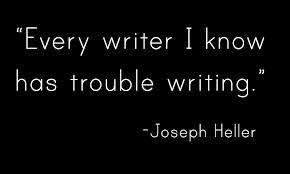
i
I love this quote from Joseph Heller. It seems that when you write, trouble is just a part of the process. I think this is so important to remember when you are writing anything, but especially when you are working on something as long and drawn out as a novel. Sometimes, when the trouble comes it seems like you will never write anything again. And that negative outlook is just no good. You begin doubting your writing ability ("I don't really think I can write anyway."), then you doubt your capability ("Even if I could write, a project like this is just beyond the scope of my abilities."), then you doubt your publishability ("Even if I ever get this thing written, no one is ever going to publish it."), finally, you doubt your salability ("Even if someone takes a chance on publishing it, no one will ever read it.") Okay, so I took some liberties with the -abilities, but you get my meaning. It all becomes a spiraling mess of self-doubt circling the trash can drain.

With this in mind, I have taken a couple of days respite from the novel to re-energize and refocus my writing. And you know what? It actually worked! Can you believe it?

If you have read my previous entries, then you know Verity (my main character) and I have been having a bit of a struggle with telling her story in a way that suited both of us. I did move forward with other aspects of the story, but because Verity is THE center of the story, it just seemed wrong to move on without her.

Yesterday, my daughter and I took a field trip. Just as Verity had to "go home," I decided I needed to take that trip myself. To go out and drive the back roads, to be out in the country (the real country), to go down those old gravel roads and pick wildflowers, to be "home."

Just for fun, here are a few of the pictures I took on our little field trip.


"Going home" has been highly productive for both me and Verity. Today, I finished Chapter 7 and half of Chapter 8. I also posted two new articles to my education blog (Building Intelligence Plus Character). All in all, a full day of work. I believe I my need to make field trips a regular part of my process. :) So, until next time. . .

Good day and Good Writing to you all!

Today's stats -

NIP - WTA - pages: 51; word count: 13621

Tuesday, July 29, 2014

Writing Day 13


In light of the way I've spent my research and writing time this evening, this particular writing problem is quite apropos. Now, you may or may not be asking yourself, "What in the world has she been doing?" Well, either way, I am going to tell you. I have spent the evening researching a wide variety of accidental deaths and writing obituaries and flash pieces. For those who don't know what flash is, flash fiction is a super short story. They are typically 1,000 words or less (some people consider flash 300 words or less).

Yes, you read that correctly. I have been writing obituaries for a few hours tonight. I wonder how many people outside of the field of journalism can say that.

Since Verity and I came to an understanding over the weekend and put her part of the story on the back burner until later this week, I worked on telling some of the other stories in the book. Verity's story is not all hers after all. Half of the story is her journey to find the truth, and the other half is her telling the stories of those unfortunate souls who no longer have a voice of their own - which, by the way, is a necessary component to her finding the truth and shedding a light on the dark past of her hometown.

I'm excited at the prospect of digging out these stories. Especially because I have absolutely no idea where they are going to end up until I begin writing them. All of the deaths are elementally-linked, so I know going in where the ultimate end is coming from (earth, air, fire, or water); however, learning the where, when, and how comes along as I write for each person or incident. Much like Verity, I have no idea exactly what happened until I see it for  myself. Once the obits are complete, the characters determine where their story will go. They tell me, and I write them down.

While this is an energizing way to write, I certainly wouldn't want anyone (particularly if you are squeamish) to look at my recent image searches. :)

I've been working in the binder today, so I have no new stats to share at the moment. I will be transcribing tomorrow, so we will see just how much work I have managed to accomplish then.

Good Day and Good Writing to you all!

Monday, July 28, 2014

Writing Days 11/12


Okay, so what can I say about this weekend. . . well, I guess I would say "interesting" just about covers it. Did I get a lot of work done? Ummm. . . not really. Did I learn a lot. Yes, yes, I did.

I started out the weekend with high expectations. I was able to get so much writing done over the week that I just knew this weekend would be full of writing genius. I set everything up to work - as is my habit - black notebook, 2 blue ink pens, cigarettes, and Diet Coke, all laid out and ready to go. I sat in my favorite spot on the front porch, opened the notebook, and. . . nothin', absolutely no single thing came to mind. I knew where the story was going. Knew what needed to be said. Knew where my character needed to go next, what she needed to do, and what obstacles were to be laid in her path. Still nothing.

I began doodling around the edges of the paper and thinking about the story. I wrote a sentence, then another, then a paragraph. And the entire time, the voice in my head kept saying, Crap! This is crap! What are you doing?

I wrote a second paragraph, finished a page, then two. But, I still couldn't shake that voice. No, no, NO! This isn't right at all.


Now, before I continue, I feel it's necessary to mention that I do not actually have schizophrenia. However, I have been living with this story for much longer than I have actually been writing it. When you read interviews with writers, many talk about writing as a kind of itch in their brains, something that keeps them up at night. That sometimes a story demands so insistently to be told that it will wake them in the middle of the night and refuses to quit until they get the ideas down on paper. That has happened to me for as long as I can remember. I sleep with a notebook and pen beside my bed (have for years and years) just so I don't have to completely get up. Hoping that if I can write it down quickly enough, I may actually be able to just drift back off to sleep quickly. Sometimes it works. Sometimes it doesn't.

But I digress. This story, and perhaps more importantly this character (Verity), has been rattling around my subconscious and my journals since an early creative writing class I took back in the spring of 2009. That is a long time for someone else to occupy that very personal space. By the time I actually started the story in 2013, Verity had already been present for four years, creeping around the periphery and pushing for her story to be told. She has changed very little over the years, other than aging a bit (she began life as a teenager, but she now lives quite happily in her late thirties).

Struggling through those Saturday morning pages, the voice seemed familiar, but I couldn't quite place it. I took a break. Walked around the yard. Then, it hit me. Verity! And, man, she was not happy with me.

I went back and re-read what I had written. Verity was right. It was crap. At this point in the story, Verity is returning to her old home place for the first time in many years. All the family is gone and all that remains is her great-grandmother's old empty house. Besides being a pivotal piece of the story, this is an important moment for Verity - an exorcism of demons, in more ways  than one. I did not do it justice. I did not do her justice. And she let me know that quite plainly.

 I knew it wasn't right, but the words still refused to come. So, what did I do?

I stepped away. I played with my granddaughter. I watched Frozen three times in a row. I went grocery shopping. I cooked supper. I took a breath. Sunday, I watched movies with my daughter and paid a long overdue visit to an old friend. I thought about the story, dreamed about it even, but did not pick it back up.

Driving the dark tree-lined road to get back to town, I realized what needed to be done. A field trip is in order. I already have it planned for Wednesday - just me, Sis, and the camera.

Until then, what's on tap for the novel? Well, fortunately for me, while this is Verity's story, it is also about her telling the stories of others. So, while her story is going to go on hold for a moment, she is going to go ahead and tell the others' stories in the meantime.

She and I are both very happy with this arrangement.